Calculating the Timeline's Key Dates
The chain of dates, step by step, and the decisions behind it
This page is the companion to How We Date Adam, which asks whether Genesis means us to build a timeline at all. Here the chain itself is set out: each dated link from 853 BC back to Adam, then the methodological decisions behind the calculation (which text tradition to follow for the patriarchal ages, whether to include Cainan, the length of the Egyptian sojourn, and the Exodus date), the full genealogical table, and the archaeology alignment. Adapted from the appendix of A Timeline of Origins (Michael D. Russell, 2024).
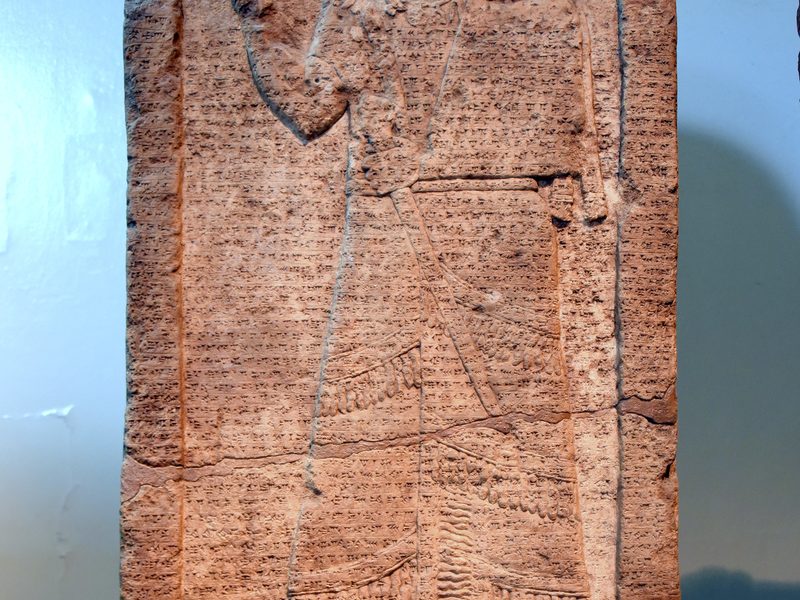
1. The starting point: 853 BC, fixed by the Kurkh Monolith
In 853 BC, the Assyrian king Shalmaneser III fought a coalition of kings at the Battle of Qarqar. His account, carved on the Kurkh Monolith now in the British Museum, names "Ahab the Israelite" among them. This date is not an estimate. The Assyrian Eponym Canon lists a named official for every year of Assyrian history; that list is anchored to a solar eclipse in 763 BC confirmed by modern astronomical calculation. The Canon fixes 853 BC for the Battle of Qarqar with as much certainty as any date in ancient history.
This is the starting point because it connects a named biblical figure (Ahab of Israel) to an independently verified calendar date. Everything else in the chain depends on this anchor.
2. The king list: Solomon's 4th year = 966 BC
The books of Kings record the length of each Israelite and Judahite king's reign. Counting backward from the death of Ahab (853 BC) through Omri, Elah, Baasha, Nadab, and Jeroboam I gives Solomon's 4th year at 966 BC. This is the year 1 Kings 6:1 identifies as the year the Temple foundations were laid. The king-list arithmetic is straightforward and widely accepted, and 966 BC is a multiply attested date.
3. Why ~300 years from Exodus to Temple, not 480
1 Kings 6:1 says the Temple was founded "in the four hundred and eightieth year after the Israelites came out of Egypt." Taken at face value, 480 years before 966 BC gives an Exodus in 1446 BC. But 480 is likely schematic rather than a precise count.
480 = 12 × 40. Twelve is the number of the tribes; forty is the standard biblical generation of the wilderness (Numbers 14:33). The author of 1 Kings 6:1 is likely saying "twelve generations elapsed": a theological statement about the completeness of the period. Supporting this: 1 Chronicles 6:3–8 lists exactly twelve Levitical generations from Aaron to the first Temple.
The judge-periods in the book of Judges, added end-to-end, sum to considerably more than 480 years, so they cannot all be consecutive. Many judges governed simultaneously in different regions of a divided land. Once overlapping reigns are identified, the real elapsed time from Exodus to Temple is likely around 300 years (Kitchen). The Septuagint version of 1 Kings 6:1 reads 440 rather than 480; the figure evidently circulated in more than one form in the early manuscript traditions, which sits comfortably with a schematic reading, though it does not settle the question.
K. A. Kitchen, On the Reliability of the Old Testament (Grand Rapids: Eerdmans, 2003).
4. The Exodus: ~1266 BC
966 BC + 300 years = 1266 BC for the Exodus. This aligns with the chronology defended by Kenneth Kitchen: the city of Rameses (Exodus 1:11), where the Israelites performed forced labour, corresponds to Pi-Ramesses, built under Ramesses II (reigned 1279–1213 BC). The biblical record places the Israelites at this city before the Exodus; Kitchen's date makes the geography work.
5. The sojourn: 215 years in Egypt
Exodus 12:40 in the Masoretic Text records "the length of time the Israelite people lived in Egypt was 430 years." But the Septuagint and Samaritan Pentateuch both read "in Egypt and Canaan": 430 years total from Abraham's covenant to the Exodus, split as 215 years in Canaan and 215 years in Egypt. Working backward from 1266 BC, Abraham left Haran in 1696 BC and was born around 1771 BC. The detailed calculation is set out below.
6. Why the Septuagint's patriarchal ages, not the Masoretic Text
The genealogies of Genesis 5 and 11 give the fathering age of each patriarch, allowing the chain of dates to be traced from Abraham back to Adam. But the Septuagint (LXX) and the Masoretic Text (MT) disagree systematically: for most post-flood patriarchs, the MT is roughly 100 years lower than the LXX for the fathering age. This single decision accounts for approximately 1,550 years of difference in the date of Adam's creation. The three arguments for preferring the LXX (the Nahor anomaly, the Methuselah and Lamech constraint, and the early external witnesses) are set out in detail below.
7. Adam: ~5159 BC
Using the LXX fathering ages and including Cainan (present in the LXX at Genesis 11:13–14 and in Luke 3:36), the patriarchal chain from Abraham's birth (1771 BC) runs back through nineteen generations to Adam's creation at approximately 5159 BC.
The complete table of dates is below. The key alignment: the flood falls at ~2903 BC (Early Dynastic Sumer); Peleg's lifetime spans ~2372–2033 BC, within which Ur-Nammu built his ziggurats (2112–2094 BC) and the Sumerian language collapsed as a living tongue, the precise convergence the Babel account predicts.
The age data: LXX or Masoretic?
Genesis 5 and 11 provide the age of each patriarch at the birth of his son, enabling date calculation backward from known dates. But the ancient textual traditions disagree on these ages. Regarding most patriarchs, there is a difference of 100 years between the Septuagint (LXX) and the Masoretic Text (MT), with the LXX providing a higher age.
For example, a translation based on the MT of Gen 5:15–17 reads: "When Mahalalel had lived 65 years, he became the father of Jared." But the LXX reads: "When Mahalalel had lived 165 years, he became the father of Jared." The total lifespan is the same in both (895 years); only the fathering age differs.
The MT/LXX decision makes around 1,550 years of difference for the date of Adam's creation, and around 950 years for the date of the flood.
The deflation hypothesis
The question is whether the LXX inflated the numbers, or the MT deflated them. Three arguments favour the deflation hypothesis (that the MT reduced the original LXX figures):
1. Nahor's anomaly. While the LXX has a 100-year higher fathering age for most patriarchs, it is only 50 years higher for Nahor (LXX: 79, MT: 29). If the LXX had been inflating each number by 100, Nahor's age could easily have gone from 29 to 129. The 50-year gap is hard to explain under the inflation hypothesis. But under the deflation hypothesis, Nahor is the only patriarch whose LXX fathering age is less than 100. A deflation of 100 years from 79 would yield a negative number, so the deflator chose 50 instead.
2. The Methuselah and Lamech constraint. Before Noah, three patriarchs (Jared, Methuselah, Lamech) have identical fathering ages in both traditions. If the MT were original, all three could easily have been inflated by 100 years. But if the LXX is original, reducing Methuselah's or Lamech's fathering ages by 100 years would make them outlive the flood. The deflator left them unchanged because he had no choice.
3. Early external witnesses. Early citations of Genesis 5 and 11 reflect LXX testimony over the MT, including Demetrius the Chronographer (c. 220 BC), Eupolemus (c. 160 BC), Pseudo-Philo's Liber Antiquitatum Biblicarum (first century AD), and Josephus (c. 94 AD). The only witness outside the MT supporting its figures is the book of Jubilees, which Henry B. Smith argues persuasively is the erroneous source for the MT's shorter chronology.
For the full scholarly argument, see Henry B. Smith, "The Case for the Septuagint's Chronology in Genesis 5 and 11" (2018).
Whether to include Cainan
The LXX of Gen 11:13b–14b includes a patriarch named Cainan between Arphaxad and Shelah, who does not appear in the MT. Luke's Gospel follows the LXX, also listing Cainan in Luke 3:36. Smith argues persuasively for Cainan's originality, and against the theory that a scribal error in Luke spread to all other manuscripts. We follow the LXX and include Cainan, which adds 130 years to the chronology.
The stay in Egypt: 215 or 430 years?
Exodus 12:40–41 says "the length of time the Israelite people lived in Egypt was 430 years." But the LXX and Samaritan Pentateuch both read "in Egypt and Canaan." We follow the LXX reading: 430 years total from Abraham's covenant to the Exodus, split as 215 years in Canaan and 215 years in Egypt. The calculation: 25 years before Isaac's birth (Abraham was 100), plus 60 years until Jacob's birth, plus 130 years (Jacob's age entering Egypt) = 215 years in Canaan, leaving 215 in Egypt.
The Exodus date
We follow the chronology advocated by Kenneth Kitchen, dating the Exodus at around 1270–1260 BC. This allows the city of Rameses (Exod 1:11) to correspond with Pi-Ramesses, built by Ramesses II (reigned 1279–1213 BC). It requires taking the "480 years" of 1 Kings 6:1 as likely schematic (12 x 40), a reading supported by the statistical improbability of so many judgeships lasting precisely 40 years and by the fact that the explicitly enumerated years in Judges sum to considerably more than 480.
Abraham's birth year
We follow James Ussher in taking Abraham to be born in the 130th year of Terah's life, rather than employing the 70 years of Gen 11:26, which we take to indicate Terah's age at the birth of an older brother. Working backward from the construction of Solomon's temple (966 BC), this yields Abraham's birth at approximately 1771 BC.
The genealogical table
Using the LXX fathering ages and the decisions above, the following table presents the timeline of the patriarchs. Following Smith's article, our decisions closely match his in most cases.
| Name | Fathering age (LXX) | Lifespan | Born (BC) | Died (BC) |
|---|---|---|---|---|
| Genesis 5: Adam to Noah | ||||
| Adam | 230 | 930 | 5159 | 4229 |
| Seth | 205 | 912 | 4929 | 4017 |
| Enosh | 190 | 905 | 4724 | 3819 |
| Kenan | 170 | 910 | 4534 | 3624 |
| Mahalalel | 165 | 895 | 4364 | 3469 |
| Jared * | 162 | 962 | 4199 | 3237 |
| Enoch | 165 | 365 | 4037 | 3672 |
| Methuselah * | 187 | 969 | 3872 | 2903 |
| Lamech * | 182 | 777 | 3685 | 2908 |
| Noah | 502 | 950 | 3503 | 2553 |
| The flood | 2903 | |||
| Genesis 11: Shem to Abraham | ||||
| Shem | 100 | 600 | 3001 | 2401 |
| Arphaxad | 135 | 565 | 2901 | 2336 |
| Cainan (LXX) | 130 | 460 | 2766 | 2306 |
| Shelah | 130 | 533 | 2636 | 2103 |
| Eber | 134 | 504 | 2506 | 2002 |
| Ur-Nammu's ziggurats | 2112–2094 | |||
| Peleg | 130 | 339 | 2372 | 2033 |
| Reu | 132 | 339 | 2242 | 1903 |
| Serug | 130 | 330 | 2110 | 1780 |
| Nahor ** | 79 | 208 | 1980 | 1772 |
| Terah | 130 | 205 | 1901 | 1696 |
| Abraham | 100 | 175 | 1771 | 1596 |
* Jared, Methuselah, and Lamech have identical fathering ages in both LXX and MT. Reducing Methuselah's or Lamech's by 100 would make them outlive the flood.
** Nahor's fathering age differs by only 50 years (LXX: 79, MT: 29), not the usual 100, because reducing 79 by 100 would yield a negative number.
How the dates align with archaeology
Using the chronology set out above, the resulting dates integrate well with mainstream archaeology:
| Event | LXX date | Archaeological context |
|---|---|---|
| The flood | ~2903 BC | Early Dynastic period in Sumer |
| Peleg's birth — the dividing of the nations begins | ~2372 BC | Akkadian Empire rises ~2334 BC; Semitic Akkadian spoken alongside Sumerian |
| Ur-Nammu's ziggurats | ~2112 BC | Within Peleg's lifetime; archaeological echo of Genesis 11 |
| Peleg's death — Babel; Sumerian gone as a spoken tongue | ~2033 BC | Ur III collapses ~2004 BC; Sumerian dies as a living language |
Further reading
The textual decisions behind this chronology are argued at much greater length by Henry B. Smith Jr., whose Genesis 5 and 11 research project reaches the same Septuagint reading by a different route. His papers are freely available.
- “The Case for the Septuagint's Chronology in Genesis 5 and 11”, Proceedings of the Eighth International Conference on Creationism (2018): 117–32.
- “On the Authenticity of Kainan, Son of Arpachshad”, with Kris J. Udd, Detroit Baptist Seminary Journal 24 (2019): 119–54.
- “Methuselah's Begetting Age in Genesis 5:25 and the Primeval Chronology of the Septuagint”, Answers Research Journal 10 (2017): 169–79.
- “1 Kings 6:1 and the Date of the Exodus from the Masoretic and Septuagint Textual Traditions”, Near East Archaeological Society Bulletin 69 (2024): 41–64.
Scripture quotations taken from The Holy Bible, New International Version® NIV®. Copyright © 1973, 1978, 1984, 2011 by Biblica, Inc.™ Used by permission. All rights reserved worldwide.