How We Date Adam
A chain of evidence from verified history to creation
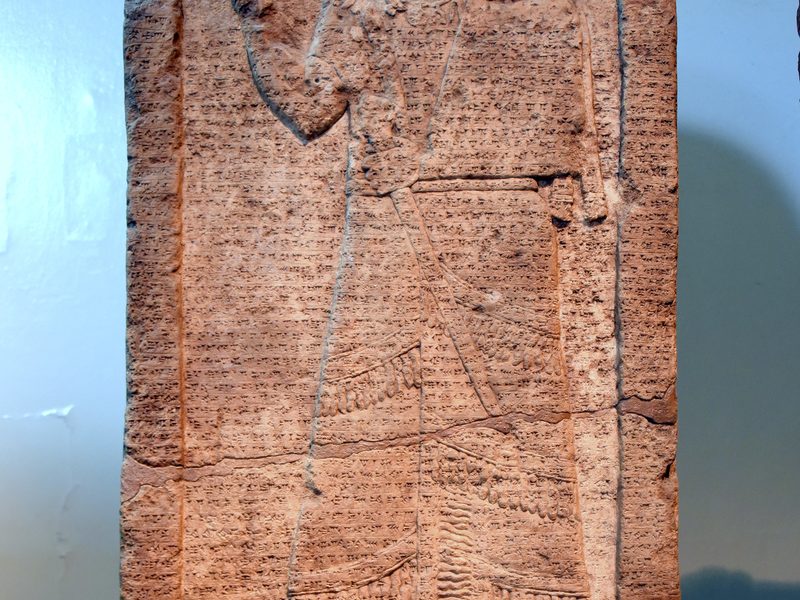
The guided journey traces a backward chain of dates from 853 BC (a year fixed by the Kurkh Monolith) to Adam's creation at approximately 5159 BC. But before any dates can be added, one question comes first: does Genesis mean us to build a timeline from its numbers at all? This page makes that case, then sketches the chain itself. The step-by-step calculation, with the genealogical table and the textual decisions behind it, is on the site's Chronology page.
Does Genesis mean us to build a timeline?
The later links in the chain rest on ordinary historical reasoning. The question Bible readers often debate is the earliest stretch: are the ages in Genesis 5 and 11 really meant to be added up? Some scholars answer no on grounds of genre. Walter Brueggemann argued that Genesis passes on a transformed and retold memory rather than a chronicle of events; Daniel Lowery called Genesis 1–11 a "poetics of protohistory." These are top-down claims about what kind of book Genesis is. They are best answered bottom-up: by looking at how Genesis actually handles its own numbers.
1. Genesis supplies exactly the data a timeline needs
A list of names alone cannot yield a timeline. One further datum is required: the age of each man when the next in line was born. That is precisely what Genesis gives, over and over: "When Seth had lived 205 years, he became the father of Enosh." (The figures here follow the Septuagint, as this chronology does throughout.) The pattern runs through Genesis 5, through Genesis 11, and on into the later narratives: Abraham's age at Isaac's birth (Genesis 21:5), Isaac's age at Jacob's (Genesis 25:26). If the intent had been only to convey the patriarchs' longevity, none of those fathering ages was needed. If the author did not want a timeline built from the age data, it is unlikely he would have taken such pains to supply exactly the data needed to build one.
2. The numbers run seamlessly into ordinary history
The long lifespans do not stop at Genesis 11. After the flood they decline steadily, generation by generation, through the patriarchal narratives and beyond: Abraham dies at 175, Isaac at 180, Moses at 120. There is no seam where "unhistorical" numbers give way to historical ones. And the narrative itself treats the early figures as real: Jacob, standing before Pharaoh, says "the years of my pilgrimage are a hundred and thirty... they do not equal the years of the pilgrimage of my fathers" (Genesis 47:9). Inside plainly historical narrative, Genesis has Jacob affirm that his ancestors lived longer than he has. The text takes its own numbers at face value.
3. Even "gaps" would not break the timeline
Since William Green's influential 1890 essay, many have argued that biblical genealogies can be compressed, with "father" sometimes meaning grandfather or a more distant ancestor, so no timeline can be built. But notice what the objection concedes: the stated age is tied to the birth of the named successor. If Seth was 205 when Enosh was born, then 205 years separate them whether Enosh was his son, his grandson, or further down the line. Making Enosh the grandson rather than the son does not change the timeline at all. Compression, even if present, leaves the arithmetic intact.
4. The flood is dated like history
Genesis fixes the flood to the six hundredth year of Noah's life, the second month, the seventeenth day of the month (Genesis 7:11). This is not a text embarrassed by its own chronology; it is a text that volunteers dates with a precision the timeline reading expects and the symbolic reading cannot explain.
5. No symbolic key has ever worked
If the ages are not age data, what are they? They do not read like random numbers, so the usual suggestion is symbolism. But no proposed symbolic scheme accounts for them. Gordon Wenham's verdict in his Genesis commentary remains accurate: "To date, then, no writer has offered an adequate explanation of these figures. If they are symbolic, it is not clear what they symbolize. If they are to be taken literally, we are left with the historical problems with which we began." The straightforward conclusion is that the numbers convey actual ages, from which a timeline can be calculated.
6. This was the default reading for most of history
Until the nineteenth century, the overwhelming consensus, from Jewish commentators before Christ, through the early church, Augustine, and Calvin, was that these ages could be added to produce a timeline. These were not readers naive about genre. The change of mind arrived in the modern era, driven primarily by pressures from outside the text rather than by anything discovered within it. The burden of proof therefore sits with those who would deny the timeline reading, not with those who affirm it.
The chain in brief
If Genesis does mean us to build the timeline, five links carry the whole chain:
- 853 BC. The Battle of Qarqar. Shalmaneser III's Kurkh Monolith names "Ahab the Israelite" among the kings who fought him, and the Assyrian Eponym Canon, anchored to a solar eclipse in 763 BC, fixes the year. Here the biblical record and independently dated history touch.
- 966 BC. Counting back from Ahab through the reign lengths recorded in Kings gives Solomon's fourth year, when the Temple foundations were laid. The king-list arithmetic is straightforward and widely accepted, and the resulting date is multiply attested.
- ~1266 BC. The Exodus. The 480 years of 1 Kings 6:1 is likely schematic (12 × 40); with the overlapping reigns of the Judges period identified, the real span is likely around 300 years (Kitchen).
- ~1771 BC. Abraham's birth, reached through the 430 years of Exodus 12:40, which the Septuagint divides between Canaan and Egypt (215 and 215).
- ~5159 BC. Adam, reached by adding the fathering ages of Genesis 5 and 11 in the Septuagint's figures, with Cainan included.
Every one of these links is argued in detail, with the full genealogical table, the Cainan question, and the textual decisions, on the site's Chronology page.
K. A. Kitchen, On the Reliability of the Old Testament (Grand Rapids: Eerdmans, 2003); Henry B. Smith Jr., "The Case for the Septuagint's Chronology in Genesis 5 and 11," ICC Proceedings (2018).
Where the chain leads
Starting from a date fixed by the Kurkh Monolith, following the biblical king-list, and applying the best available textual and historical scholarship at each step, the chain arrives at Adam's creation at approximately 5159 BC, just over 7,000 years ago.
This map does not claim to prove the biblical account. It shows that the chronology set out here, taken seriously and applied carefully, produces a timeline that is consistent with what we know from mainstream archaeology and history. The dates fit. The convergences are real. The argument is testable.
Adapted from A Timeline of Origins (Michael D. Russell, 2024). Gordon Wenham, Genesis 1–15 (Word, 1987), 134; William H. Green, "Primeval Chronology," Bibliotheca Sacra 47 (1890); Jeremy Sexton, "Evangelicalism's Search for Chronological Gaps in Genesis 5 and 11," JETS 61.1 (2018).
Scripture quotations taken from The Holy Bible, New International Version® NIV®. Copyright © 1973, 1978, 1984, 2011 by Biblica, Inc.™ Used by permission. All rights reserved worldwide.