How Nations Spread after the Flood
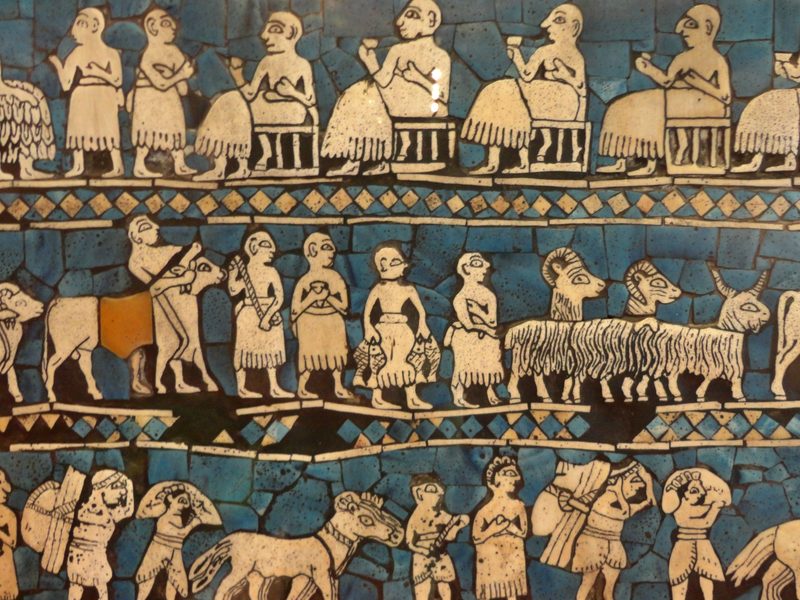
After the flood, Genesis 10 traces the descendants of Shem, Ham and Japheth through their clans, languages, lands and nations. The chapter ends with a sweeping claim:
“These are the clans of Noah’s sons, according to their lines of descent, within their nations. From these the nations spread out over the earth after the flood.”
Genesis 10:32
Read as an account of biology, this verse seems to say that every people now on earth descends from three brothers who stepped off one boat around 2900 BC. That is exactly where a historical reading of Genesis looks impossible. The peoples of Australia, the Americas and Africa were already here, living continuously, long before that date and long after it. Egypt kept its records straight through. On the face of it the history rules the story out, and many conclude that Genesis 1–11 simply cannot be read as history.
This guided journey proposes that you do not have to choose between taking Genesis seriously as history and taking that evidence seriously. Two moves, both set up in the earlier arguments, let the historical reading stand. First, the flood destroyed the ancient world, not ours. Second, Genesis 10 describes the spread of nations, an organised form of society, through peoples who were already living here, rather than the first arrival of human beings in every land.
This is a proposal, offered to be weighed against the alternatives rather than asserted as a certainty. What follows makes the case that it is at least as plausible as any of them, and pays a lower price than each.
What the earlier arguments established
Two findings from the earlier guided journeys carry into this one. The first is that Genesis describes two physically distinct worlds. Peter calls the world drowned by the flood “the ancient world” (2 Peter 2:5), and sets it apart from “the present heavens and earth,” which await a different judgment altogether (2 Peter 3:5–7). The map shows that ancient world alongside ours.
The second is that our world was already inhabited. Genesis 4 has Cain, banished for murdering Abel, afraid that “whoever” finds him will kill him. He takes a wife and builds a city. This is not a lonely man waiting for siblings to be born; it is a man entering a place where other people already live. The Cain guided journey makes the case that his banishment is the first crossing from the ancient world into ours. So well before Noah, our world already held widely dispersed human populations. Both moves in this argument rest on those two results.
The flood destroyed the ancient world
The flood account insists, over and over, that the destruction was total. God says he will destroy “both them and the earth” (Genesis 6:13), and afterwards promises that “never again will there be a flood to destroy the earth” (Genesis 9:11). The Hebrew verb behind “destroy,” shachat, means to ruin or annihilate. The waters rise over the mountains and stand there for 150 days. Every reader, ancient or modern, knows that trees and plants do not survive 150 days beneath deep water. Genesis 7:11 even opens the doors of the firmament, releasing the waters held above the sky, water that could be released only once.
Taken plainly, the account says the world of that time was not merely swamped but ended, rendered permanently uninhabitable. Hold on to that, because it sets up the puzzle in the very next scene.
Choose your miracle
Noah sends out a dove, and it returns: “there in its beak was a freshly plucked olive leaf” (Genesis 8:11). The Hebrew opens that clause with hinneh, “behold”, a word that points and says: look, this is remarkable. And it is. After a judgment the text has just called total, after 150 days under deep water, a living, freshly plucked olive leaf is precisely what should not exist. Something extraordinary has happened.
So a miracle is on offer, and the only question is which one. Either God kept the world’s vegetation alive through 150 days submerged and then made an ocean of water disappear, or God carried Noah, the ark and its cargo out of the drowned ancient world and into a living one, the same crossing Cain had made generations before. Both are miracles; the text forces you to choose one. The second is at least as plausible as the first, and it plausibly fits many things the account goes on to tell us has changed.
A world that behaves differently
The clearest of those changes is hidden in the ages of the patriarchs. Before the flood they live about nine hundred years, with no sign of decline: Adam reaches 930, Noah 950. Only after the flood do the numbers fall, generation by generation, sliding toward our own. The conditions of life themselves seem to have changed.
Watch it surface centuries later. Jacob stands before Pharaoh, who asks his age. Jacob answers that his 130 years are “few and difficult,” and short of his fathers’ years (Genesis 47:9). The striking thing is that Pharaoh, ruler of a long-established nation, seems not to know about such lifespans already; Jacob has to explain himself. That is just what we would expect if Jacob belonged to a small line of long-lived people, descended through Noah from the older world, living among a far larger population whose lifespans had always been ordinary.
Two smaller changes point the same way. God says of the rainbow, “I have set my rainbow in the clouds” (Genesis 9:13), the language of something newly appointed, not of a familiar sight given fresh meaning. And the animals’ fear of human beings “will fall” on them from now on (Genesis 9:2), a permanent, universal shift that fits entry into a new world better than the memory of a year aboard the ark. No single detail settles the question. Together, the total destruction, the olive leaf, the collapsing lifespans, the new rainbow and the newly wary animals all lean the same way.
What, then, spread from Noah’s sons?
Return now to Genesis 10:32, with the two-worlds reading and the categories the earlier guided journeys drew already in hand. If the ark arrived in an inhabited world, the Table of Nations is not naming Noah’s family as the first people of every land. It tells us only what spread from them: “From these the nations spread out over the earth after the flood.”
Genesis 10 is careful to keep “nation” distinct from the other ways human beings are grouped. Alongside the word goy, “nation,” the chapter names language, clan, kingdom, city, territory and line of descent (Genesis 10:5, 20, 31). Six categories stand beside the seventh. This is not a text using “nation” as a loose synonym for people who migrated and multiplied. Nor is it saying that organised society as such spread out over the earth: clans, families, cities and languages each have their own kind of organisation of society. What spread out through the clans of Noah’s sons was one particular kind of organised society: the nation. And if our world was already full of peoples, then it spread through them.
How far, then, did it spread? “Over the earth” need not mean every nation on the planet across the whole of history. It reads more naturally as the earth Genesis has in view: the nations coming into the writer’s horizon, spreading out across the world he knew. The claim is that those nations, the ones actually in the account’s sight, trace back to Noah’s sons, and that this is significant for the history of nations. It is not a claim that a people on the far side of the globe, never in contact with that world, must somehow be joined to it.
Nations as organised societies
The Bible never hands us a technical definition, and we should not read the modern nation-state back into Genesis. But it gives a recognisable pattern. Egypt is said to have “become a nation” (Exodus 9:24), the language of a historical development, not of mere population growth. Israel is already “a holy nation” at Sinai (Exodus 19:6), before it has a king, bound together by covenant, law, worship and leadership, and it remains Israel through Moses, the judges and a line of kings.
A workable description, then: a nation is an organised society with a shared public life, ordinarily tied to a land, and able to continue through changes of generation and ruler. That is what Genesis says spread out over the earth, and it is a different thing from the spread of population.
A New Testament echo
Paul in Athens says that from one man God “made all the nations, that they should inhabit the whole earth”, and that he “marked out their appointed times in history and the boundaries of their lands” (Acts 17:26). The verse is usually read as being about Adam and biological descent, partly because the familiar older translations say “of one blood”; but the word “blood” is a later textual variant, absent from the earliest manuscripts. Read without it, Paul’s subject is nations, with their appointed times and boundaries of lands, and John Walton has argued that the statement “could easily be seen as a paraphrase of what is stated in Genesis 10.” On that reading the one man is Noah, and Paul is summarising the very spread this page describes. The referent is genuinely debated, and we hold the reading as plausible rather than settled; but it is striking that the New Testament’s one sentence on the origin of the nations fits the socio-political reading of Genesis 10 so naturally.
A chain you can trace
On the map, Noah’s family arrives near Ararat and moves into the wider Mesopotamian world. Genesis 11 finds one community, with one language, on the plain of Shinar; the next guided journey asks whether that language was Sumerian, the tongue of the ancient world, carried across into ours by Cain and again by Noah and his family. From there the map follows organised nationhood as it is handed on from one society to the next, by the ordinary means through which such influence has always travelled: migration, trade, alliance, conquest and imitation.
This is the claim the map actually puts to the test. Not the two-worlds reading, which no map could settle, but the spread itself: can organised nationhood be traced, step by step, from the Sumerian world outward through the societies that inherited from it, back toward Noah? This is largely fresh ground. We used two AI assistants, Claude and ChatGPT, to propose which historical peoples are best called nations, and where each most likely derived its nationhood from; those are proposals offered for testing, not settled findings. And not every nation in history need fit them. Some peoples, in the Americas or elsewhere, may well count as nations on the definition used here while belonging to no such chain, and that leaves the thesis standing, because the claim was never that every nation traces back to Noah, only that the nations within Genesis’s horizon do.
Egypt, and the honest limit
Egypt marks the boundary of the claim. It had a unified kingdom before the date proposed here for the flood, and Exodus itself recalls a time “since it had become a nation” (Exodus 9:24). We are not claiming that Noah’s descendants invented the first nation, or every nation. Genesis 10 later places Mizraim, that is Egypt, in Ham’s line, which may describe Ham’s descendants becoming identified with an existing nation rather than founding it.
This fits the text rather than straining it. Wenham notes that the names in Genesis 10 are unlikely to be all eponyms, ancestors from whom a whole people descends; in the ancient world “son of” and “brother” could mark a treaty tie as readily as blood. The Table of Nations therefore leaves room for peoples to draw much of their stock from outside Noah’s family, while still receiving, through his descendants, the organised nationhood that spread among them. The claim stays large without needing to be total.
Why this lets Genesis be read as history
This proposal has two moving parts, and each holds the other up. The first is the two-worlds reading of the flood: the world the waters destroyed was the ancient one, not ours. The second is the reading of Genesis 10:32 as the spread of a polity rather than of biology, organised nationhood moving through peoples already here, not bloodlines filling an empty earth. The first makes room for the second, since a world already inhabited is a world through which nations can spread. And the second repays the first, since a visible, traceable spread of organised nationhood is just what we should expect if Noah’s line entered an already peopled world.
Set the pair beside the main alternatives that share a high view of Scripture, and weigh the strengths and weaknesses of each. A global flood in our own world has to explain why our animals and peoples do not look descended from a single boat five thousand years ago, why every species of lemur lives in Madagascar and nowhere else, and why no trail of settlers marks the journey there. A local flood, or a flood-myth retold, sits easily with that continuity, but struggles to do justice to a text that insists three times over that everything was destroyed and dates the event to the very day.
Weighed on the same scales, our claim is that this reading is at least as plausible as either. The ancient world really was destroyed, exactly as Genesis says. Our world kept its peoples, its animals and its history, exactly as the evidence says. Noah and his family remain real people arriving at a real time, and Genesis 10 describes a real spread of nations through peoples already here. It does not prove every link drawn on the map. What it does is gather Cain’s banishment, the totality of the flood, the unbroken population of our world and what Genesis 10:32 claims about the spread of nations into a single account, and let Genesis 1–11 be read as history without pretending the evidence away.
How this refines A Timeline of Origins
A Timeline of Origins leaned towards a single chain in which all nationhood ultimately spread from Noah’s descendants. Here the claim is made more precise, and more modest. Genesis 10:32 need not say that every nation on earth traces back to Noah’s sons. It is enough that the nations in the writer’s horizon, those spreading out across the world he knew, can be traced to them, and that this is significant for the history of nations. So the chapter describes a real and far-reaching movement beginning with Shem, Ham and Japheth, while leaving open both that comparable societies arose on their own, Egypt among them, and that peoples beyond its horizon need never have been joined to it. What remains is substantial: Noah’s family arrived in an inhabited world, and their descendants had an extraordinary part in shaping the nations Scripture actually has in view.
Develops chapters 2 and 4 of A Timeline of Origins (Michael D. Russell, 2024). Gordon Wenham, Genesis 1–15 (Word, 1987), 215; John H. Walton, “A Historical Adam: Archetypal Creation View,” in Four Views on the Historical Adam (Grand Rapids: Zondervan, 2013), 105.
Scripture quotations taken from The Holy Bible, New International Version® NIV®. Copyright © 1973, 1978, 1984, 2011 by Biblica, Inc.™ Used by permission. All rights reserved worldwide.