· A companion to A Timeline of Origins
On the book
“On every page I found myself saying, ‘…but what about…?’ Then, on every next page, ‘Oh right. I guess that does work.’ The refreshing combination of a high view of Scripture, an acceptance of mainstream Science, and a dogged attention to the details of the Biblical text will make this book both productive and discomforting for virtually everyone who reads it!”
Dr. Lewis Jones, Director, The Simeon Network (AFES)
On the book
“Thought-provoking and plausible. The two-worlds theory removes some of the clashes between mainstream scientific knowledge and interpreting Scripture as a factual historical account, and leads to intriguing, testable hypotheses.”
Prof. Janice Siegford, Michigan State University

About this site
A close reading of early Genesis, presented through maps and walkthroughs, that fits history and science well. A case for Jesus from the whole Old Testament and the first witnesses.
About the author
Mike Russell is the Senior Minister at St George's Anglican Church, Magill, and the 18th rector of the parish. He is married to Ally, and they have four children. He was converted and baptised at 17 through Trinity Chapel Macquarie, studied undergraduate theology at Moore College, and completed a Master of Theology through Bible College SA.
This site grows out of his book A Timeline of Origins, and sits alongside his other work in theology, ethics, biblical interpretation, and the public case for Christ.
Have questions about a nation's classification? Found a source worth weighing? Disagree with a date? Send a note and help make the map sharper.
This map takes two bodies of evidence seriously at once. Mainstream history tells us the world was already inhabited long before the biblical date of the flood: peoples were living across the Americas, Australia, and sub-Saharan Africa millennia before Noah. The Bible tells us that nations spread to the ends of the earth through the families of Noah's three sons: "from these the nations spread out over the earth after the flood" (Gen 10:32). Both can be accepted. But under the obvious reading, they conflict.
If "nations spreading to the ends of the earth" simply means "peoples getting to all places on earth," then those two claims sit in tension, since peoples have been living across the Americas, Australia, and sub-Saharan Africa for millennia before the time of Noah. The only way to hold both claims at once is to distinguish peoples from nations. A people and a nation are not the same thing. Peoples can exist without being nations: families, clans, and tribes can occupy territory for centuries without forming the kind of entity that Genesis 10:32 describes spreading. Nationhood is a specific socio-political form, with recognised territory, centralised authority, legal structures, and institutions that persist beyond individual rulers. It can exist among a people, but it does not arise automatically.
The reading explored here is that Genesis 10:32 describes the spread of that form. What Noah's descendants carried to already-inhabited peoples was not their bloodline but a way of organising human life into nations. No people group becomes a nation until it has had contact with an existing nation. If that is right, every nation on earth traces its nationhood back through an unbroken chain of contact to Noah's descendants, beginning, on this site's proposed reading, at Sumer.
That claim is testable. If it holds, the map should show it: every nation will have a visible chain tracing back to Sumer, with no nation appearing without a prior contact. We argue four things to support it:
We identify a nation using six criteria drawn from the Hebrew word goy and its usage in the Old Testament:
Centralised authority is necessary for nationhood, but it is not sufficient. The Aztecs had a king. The Incas had a supreme ruler. Neither had a nation in the sense Genesis 10:32 describes: when their rulers were captured, their political structures collapsed, because the state was not yet independent of the person who held it. What the contact chain transmits is precisely criterion 6: the concept of the state as an entity distinct from its ruler, giving institutions the capacity to survive a change of government. Kings arise independently; that quality does not.
The Hebrew word goy has a broader semantic range than these six criteria; Deuteronomy 7:1 lists seven goyim including the Perizzites, whose name may mean "villagers," hardly a centralised state. But our criteria identify the specific socio-political entity that Genesis 10:32 describes spreading across the earth from Sumer.
This is why some impressive civilisations are not shown as nations on this map. The Indus Valley Civilisation (~2600 BC) had planned cities, standardised weights, and long-distance trade, but no evidence of centralised political authority: no palaces, no royal tombs, no depictions of rulers. It appears on the map as a people group, not a nation. Conversely, some small entities are identified as nations because they meet all six criteria.
On this map, every nation has a visible chain of contact tracing back to Sumer. A dot travels from an existing nation to the location where a new one forms. No nation appears in isolation.
God "made from one man every nation of mankind to live on all the face of the earth, having determined allotted periods and the boundaries of their dwelling place" (Acts 17:26). Nationhood, on this reading, is not merely a human invention; it is a form of ordering human life that God distributes through history.
On this map, you can trace that pattern: Noah's descendants leave Sumer during Peleg's lifetime (~2370–2033 BC), and from that point, every new nation forms through contact with a nation that already exists.
The strongest challenge to the contact-chain thesis comes from pre-Columbian civilisations in the Americas. The Maya, Aztec, and Inca empires developed impressive political structures with centralised authority, territorial control, and vast populations. They meet many of the criteria listed above.
Yet there is a consistent, observable pattern across all major pre-Columbian civilisations: none of them produced political institutions that survived a change of regime. When the Classic Maya civilisation collapsed (~900 AD), cities were abandoned wholesale. When Montezuma was captured in 1519, the Aztec Empire collapsed within months. When Pizarro captured Atahualpa in 1532, the Inca Empire fragmented almost immediately.
This contrasts sharply with Old World nations, where institutional survival across regime changes is the norm. Persian institutions survived Alexander. Roman institutions survived the fall of the Western Empire. Chinese dynastic institutions survived across dynasty changes. Even small nations like Judah preserved their institutional identity through exile in Babylon.
The contact-chain thesis offers an explanation: the chain transmits the concept of the state as an entity separate from its ruler, which is what gives institutions the ability to survive regime change (criterion 6 above). Without the chain, peoples can build impressive political structures, but those structures remain fused with specific rulers. This pattern is suggestive but not conclusive.
If nationhood is a transmitted institutional framework, then the depth of contact should matter, and it does. Nations that received nationhood through deep, sustained institutional contact (India, South Korea, most of Europe) tend to be robust and stable. Nations that received it through shallow or recent contact tend to be fragile, with tribal or people-group dynamics still dominant beneath the surface.
This variation is itself evidence for the thesis. If nationhood were merely a political designation, all post-colonial states should function equally well as nations. But they do not. The depth and duration of institutional transmission affects the result. Shallow contact produces fragile states; deep contact produces robust nations. Some entities on this map that are recognised as nations may in practice still be closer to collections of people groups in the process of becoming nations.
Genesis 10 lists the descendants of Noah's three sons (Shem, Ham, and Japheth) and associates each with particular territories. These associations align remarkably well with what we know from archaeology and ancient history:
| Genesis 10 name | Lineage | Historical identification |
|---|---|---|
| Madai | Son of Japheth (10:2) | The Medes of the Iranian plateau |
| Javan | Son of Japheth (10:2) | The Ionians / Greeks of the Aegean |
| Mizraim | Son of Ham (10:6) | Egypt (Hebrew name for Egypt) |
| Cush | Son of Ham (10:6) | Kingdom of Kush in the upper Nile |
| Canaan | Son of Ham (10:6) | Peoples of the Levant |
| Elam | Son of Shem (10:22) | Civilisation in southwestern Iran |
| Asshur | Son of Shem (10:22) | Assyria in northern Mesopotamia |
| Aram | Son of Shem (10:22) | Aramaeans of Syria |
| Lud | Son of Shem (10:22) | Lydia in western Anatolia |
On the map, these correspondences are visible: coloured dots (blue for Shem, red for Ham, green for Japheth) leave Sumer at Babel and head toward exactly these territories. Each dot is labelled with its Genesis 10 name.
Nimrod (Gen 10:8–12) is a particularly interesting case. A descendant of Ham, he establishes a kingdom (Hebrew: mamlakah) in Shinar, Shemite territory, then expands it northward into Assyria. The institution crosses ethnic lines and travels beyond its founding context, taking root among new peoples in new territory. This is what distinguishes a transmitted political form from the personal domain of a strong individual: it is portable. The resulting kingdoms of Babylon and Assyria retain their Shemite cultural identity while being organised under, and eventually beyond, Hamite political initiative.
The dates on this map rest on a number of chronological decisions, one of which is the use of the Septuagint (LXX) fathering ages in Genesis 5 and 11 rather than those of the Masoretic Text used in most English Bibles. The resulting dates integrate well with mainstream archaeology: the flood aligns with the Early Dynastic period in Sumer (~2903 BC), the dispersal of nations begins during a period of known cultural expansion (~2372 BC), and the collapse of Sumerian civilisation coincides with the end of Peleg's lifetime (~2033 BC).
For the full chronological argument, including the case for the Septuagint, the complete genealogical table, and key date calculations, see our Chronology page (technical).
This map does not claim to prove the biblical account. It shows that Genesis 10–11, read alongside the chronology set out here, produces a narrative that is consistent with what we know from mainstream archaeology and history.
As you watch the timeline, notice how every nation that appears connects back through an unbroken chain to Sumer. Notice how the Genesis 10 names correspond to real historical peoples. Notice how the dates fit. The Bible's account of how nations spread is not a myth imposed on history; it is a framework that integrates plausibly with everything we know.
Genesis 11:1 says that "the whole earth had one language and the same words." This map explores whether that claim is plausible by tracing the history of languages alongside what we know from linguistics, archaeology, and the ancient Near East.
We argue four things:
Genesis 4 itself contains the strongest evidence that Cain entered a world that already had people. The traditional reading is that Cain's wife was a sister and those he feared were his own relatives. But the text strains against this. When Cain was exiled to the land of Nod, he said "whoever finds me will kill me." If he were heading into an empty land, we would expect the text to note his isolation, as it did when Adam was alone, prompting God to say "it is not good for man to be alone" (Gen 2:18). Instead, Cain's immediate response was fear of being killed by strangers. God placed a permanent mark on him, endorsing that fear as real and lasting. Separately, the text introduces his wife and his city before mentioning any siblings, which inclines the reader to conclude that the people of Nod were not from his family. And the banishment was irreversible. Neither Cain nor his descendants could cross back. The people he feared could not have been family coming in pursuit. They were strangers, already in the land.
The two-worlds thesis is the reading that makes consistent sense of those details: Adam and his descendants lived in a world physically separate from ours. In that world, all spoke one language. In our world, many forms of speech had been developing for tens of thousands of years. Arriving among those who did not share his language is one reason, perhaps, why Cain feared them.
When Cain was expelled into our world (~5080 BC), he brought that language with him. His descendants built the first urban civilisation in Sumer. When the flood destroyed the world Adam and Eve had lived in (~2900 BC), Noah's ark came to rest at Ararat. Noah's descendants settled in Mesopotamia, speaking the same language.
On this reading, "the language of the whole earth" (Gen 11:1) refers to the world Adam and Eve had lived in, where it was indeed the only language. In our world, it was always one language among many, but it was the language of the people who tried to "make a name for themselves" (Gen 11:4) among the other peoples around them.
This also explains a well-known puzzle in Genesis. Chapter 10 lists Noah's descendants "by their clans and languages, in their territories and nations" (Gen 10:5, 20, 31), yet chapter 11 says "the whole earth had one language." On the two-worlds reading, there is no contradiction. Genesis 10 is a retrospective summary of where Noah's descendants eventually settled, after the Babel event scattered them into a world that already had diverse languages and peoples. The linguistic diversity of Genesis 10 belongs to the world they settled into, not the single language they brought with them.
Multiple lines of evidence point to the Sumerian language as the one described in Genesis 11:
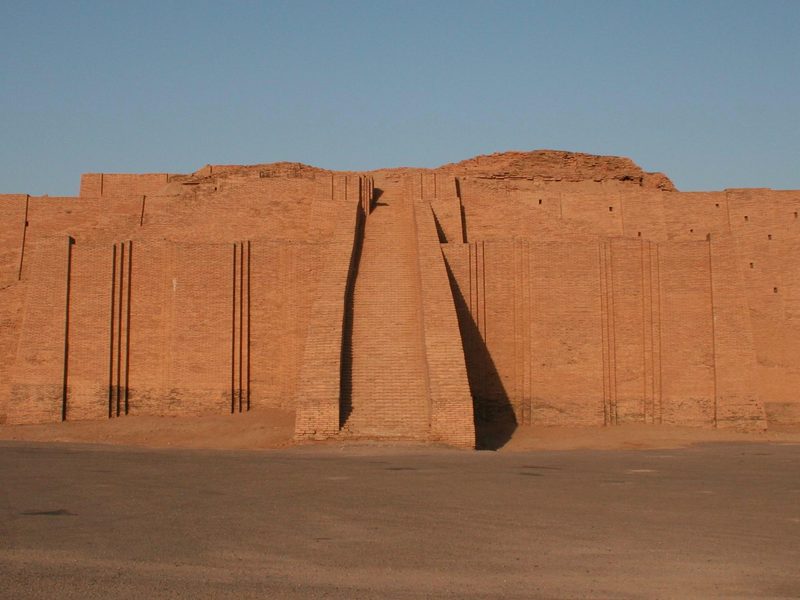
The biblical text also locates the tower in "the land of Shinar" (Gen 11:2), a word that may derive from a Sumerian term for their own territory. And the world's first writing system was Sumerian, consistent with the advanced capabilities Genesis attributes to Adam's line.
Taken together, this evidence makes a strong cumulative case that the Tower of Babel account describes the decline of the Sumerian language and the dispersion of its speakers.
Many well-known language isolates become easier to understand when you put them on a map. Basque survived in the Pyrenees mountains. Korean persists on its peninsula. Ainu was preserved at the island edge of northern Japan. Burushaski endures in the remote valleys of the Karakoram. Zuni occupies the high desert of New Mexico. The argument is not that geography explains every isolate exhaustively, but that physical barriers often make linguistic isolation plausible.
Sumerian is the striking exception. It existed in the flat, open plains of Mesopotamia, at the crossroads of major trade routes, in constant contact with other linguistic groups. It was not isolated at all. And yet it has no known linguistic relatives. None.
Compare Sumerian with every other major language of the ancient Near East. Akkadian belongs to the Semitic family. Hittite belongs to the Indo-European family. Egyptian belongs to the Afro-Asiatic family. Every other major river valley civilisation, the Nile, the Indus, the Yellow River, produced languages that fit within known language families. Sumerian stands alone.
If geographic isolation does not explain Sumerian's linguistic isolation, what does? The two-worlds thesis offers an answer: Sumerian was brought from outside our world entirely. It has no relatives because it did not evolve alongside the languages of our world.
The record of Sumerian's extinction adds a second, independent line of evidence. Dominant languages normally leave descendants: Latin became French, Spanish, and Italian; Akkadian's Semitic family lives on in Aramaic, Arabic, and Hebrew. Sumerian left nothing. Roux called what happened a "linguistic revolution": the rapid displacement of Sumerian by Akkadian following the fall of Ur. The result is two anomalies that stand independently in the linguistic record: a language isolate with no geographic explanation, and a dominant language that vanished without descendants. The reading proposed here addresses both from the same starting point. Sumerian had no relatives because it came from outside our world. It left no descendants because, on this reading, it ended by divine scattering into a world already full of other languages, absorbed into families it had never belonged to. Two anomalies; one coherent account. That is not proof, but it is the kind of convergence that makes a reading worth taking seriously.
After the Babel event, the Bible makes no claims about which languages map to which people group. Languages diversify through the normal processes of migration, trade, and cultural contact, and the historical record matches this expectation.
Hebrew emerges as a distinct language by the time of Jacob (~1600 BC). In Genesis 31:47, Jacob calls a memorial heap "Galeed" (Hebrew) while his Aramaic-speaking relative Laban calls it "Jegar Sahadutha" (Aramaic). By this point, the patriarchs' speech had diverged from the Semitic dialects of Mesopotamia. Moses wrote the Torah in Hebrew during the Exodus (~1270 BC), the oldest sustained literary work in the language.
Aramaic rose to become the lingua franca from Egypt to India by 600 BC, the administrative language of the Persian Empire and the everyday language of Jesus. Greek spread with Alexander's conquests and became the language of the New Testament, ensuring the gospel could reach the widest possible audience. The rise and fall of languages follows patterns that are well documented and entirely consistent with a post-Babel world.
The map accessible from the home page includes a guided languages walkthrough that traces the evidence in sequence: Sumerian appearing in our world with Cain's descendants, continuing through the flood, and ending at Babel: a language with no relatives, absorbed into a world already full of other tongues, leaving no descendants.
The account set out on this page does not claim to prove the biblical text. It offers a reading of Genesis 4, 5, 6–9, 10, and 11 that addresses independently attested anomalies in the linguistic record and coheres with what scholarship has established about the ancient Near East. The reading is a proposal; the convergence it produces across two anomalies, four lines of evidence, and multiple passages of Scripture is, we think, worth serious consideration.
A chain of evidence from verified history to creation
The walkthrough traces a backward chain of evidence from 853 BC (a date fixed by astronomy) to Adam's creation at approximately 5159 BC. Each link in the chain is independently defensible. This page sets out the argument behind every step.
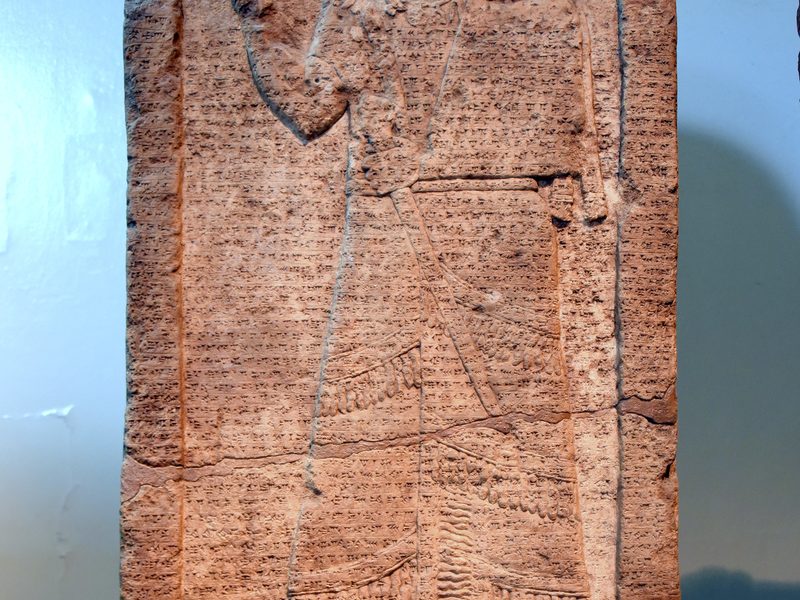
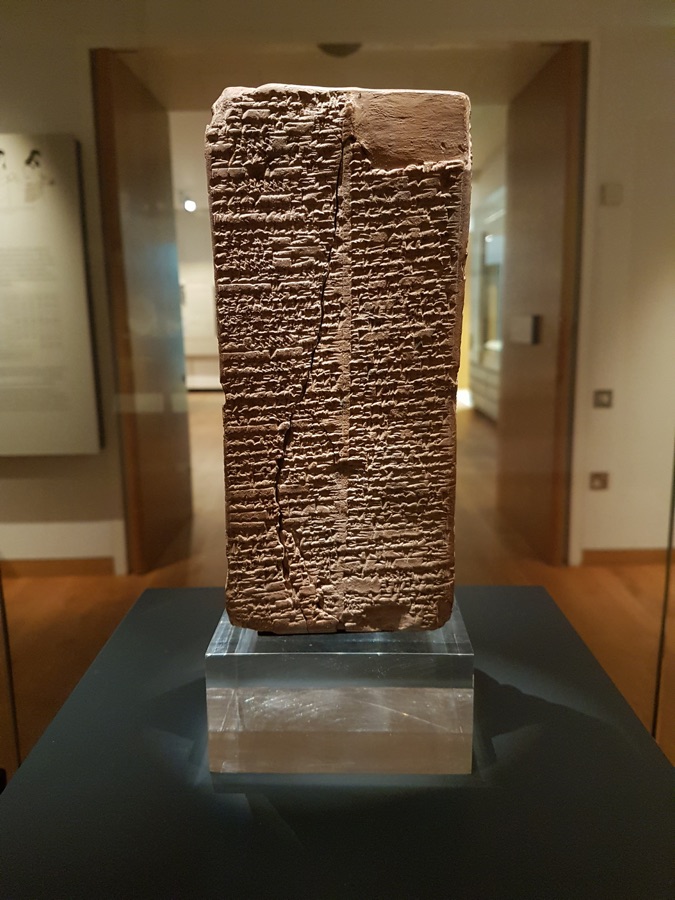
In 853 BC, the Assyrian king Shalmaneser III fought a coalition of kings at the Battle of Qarqar. His account, carved on the Kurkh Monolith now in the British Museum, names "Ahab the Israelite" among them. This date is not an estimate. The Assyrian Eponym Canon lists a named official for every year of Assyrian history; that list is anchored to a solar eclipse in 763 BC confirmed by modern astronomical calculation. The Canon fixes 853 BC for the Battle of Qarqar with as much certainty as any date in ancient history.
This is the starting point because it connects a named biblical figure (Ahab of Israel) to an independently verified calendar date. Everything else in the chain depends on this anchor.
The books of Kings record the length of each Israelite and Judahite king's reign. Counting backward from the death of Ahab (853 BC) through Omri, Elah, Baasha, Nadab, and Jeroboam I gives Solomon's 4th year at 966 BC. This is the year 1 Kings 6:1 identifies as the year the Temple foundations were laid. The king-list arithmetic is straightforward and not disputed.
1 Kings 6:1 says the Temple was founded "in the 480th year after the people of Israel came out of Egypt." Taken at face value, 480 years before 966 BC gives an Exodus in 1446 BC. But 480 is almost certainly schematic rather than a precise count.
480 = 12 × 40. Twelve is the number of the tribes; forty is the standard biblical generation of the wilderness (Numbers 14:33). The author of 1 Kings 6:1 is saying "twelve generations elapsed": a theological statement about the completeness of the period. Supporting this: 1 Chronicles 6:3–8 lists exactly twelve Levitical generations from Aaron to the first Temple.
The judge-periods in the book of Judges, added end-to-end, sum to considerably more than 480 years — proof that they cannot all be consecutive. Many judges governed simultaneously in different regions of a divided land. Once overlapping reigns are identified, the real elapsed time from Exodus to Temple is approximately 300 years (Kitchen). The Septuagint version of 1 Kings 6:1 independently reads 440, not 480 — confirmation from a major early manuscript tradition that the number was not treated as a fixed historical datum.
966 BC + 300 years = 1266 BC for the Exodus. This aligns with the chronology defended by Kenneth Kitchen: the city of Rameses (Exodus 1:11), where the Israelites performed forced labour, corresponds to Pi-Ramesses, built under Ramesses II (reigned 1279–1213 BC). The biblical record places the Israelites at this city before the Exodus; Kitchen's date makes the geography work.
Exodus 12:40 in the Masoretic Text records "the length of time the Israelite people lived in Egypt was 430 years." But the Septuagint and Samaritan Pentateuch both read "in Egypt and Canaan": 430 years total from Abraham's covenant to the Exodus, split as 215 years in Canaan and 215 years in Egypt. Working backward from 1266 BC, Abraham left Haran in 1696 BC and was born around 1771 BC. The detailed calculation is on the Chronology page.
The genealogies of Genesis 5 and 11 give the fathering age of each patriarch, allowing the chain of dates to be traced from Abraham back to Adam. But the Septuagint (LXX) and the Masoretic Text (MT) disagree systematically: for most post-flood patriarchs, the MT is roughly 100 years lower than the LXX for the fathering age. This single decision accounts for approximately 1,550 years of difference in the date of Adam's creation.
Three arguments favour the LXX as the original text. First, the Nahor anomaly: the LXX is only 50 years higher for Nahor, not the usual 100, because reducing his LXX fathering age of 79 by 100 would yield a negative number; the anomaly is precisely explained by deflation, not inflation. Second, the Methuselah and Lamech constraint: reducing their fathering ages by 100 would make them outlive the flood, a theological impossibility the deflator had to avoid, so he left them unchanged. Third, multiple independent first-century witnesses — Demetrius, Eupolemus, Pseudo-Philo, and Josephus — all cite figures consistent with the LXX, confirming the longer numbers existed in Hebrew manuscripts before the Greek translation.
For the full technical case, including the genealogical table and the Cainan question, see the Chronology page. Scholarly argument: Henry B. Smith Jr., "The Case for the Septuagint's Chronology in Genesis 5 and 11," ICC Proceedings (2018).
Using the LXX fathering ages and including Cainan (present in the LXX at Genesis 11:13–14 and in Luke 3:36), the patriarchal chain from Abraham's birth (1771 BC) runs back through nineteen generations to Adam's creation at approximately 5159 BC.
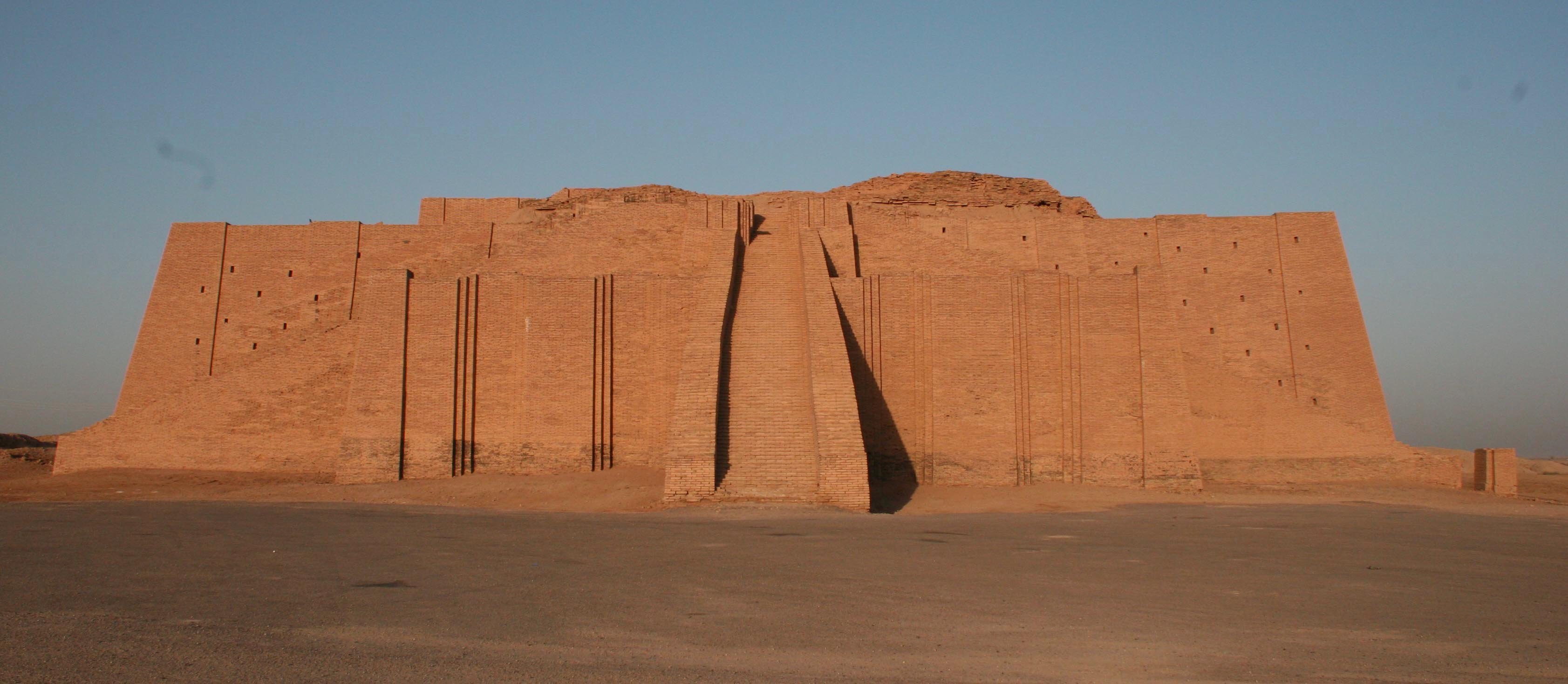
The complete table of dates is on the Chronology page. The key alignment: the flood falls at ~2903 BC (Early Dynastic Sumer); Peleg's lifetime spans ~2372–2033 BC, within which Ur-Nammu built his ziggurats (2112–2094 BC) and the Sumerian language collapsed as a living tongue, the precise convergence the Babel account predicts.
Starting from a date confirmed by a solar eclipse, following the biblical king-list, and applying the best available textual and historical scholarship at each step, the chain arrives at Adam's creation at approximately 5159 BC, just over 7,000 years ago.
This map does not claim to prove the biblical account. It shows that the chronology set out here, taken seriously and applied carefully, produces a timeline that is consistent with what we know from mainstream archaeology and history. The dates fit. The convergences are real. The argument is testable.
A technical deep-dive for the chronologically curious
This page is the technical companion to How We Date Adam. It sets out the methodological decisions behind each step of the chain argument: which text tradition to follow for the patriarchal ages, whether to include Cainan, the length of the Egyptian sojourn, and the Exodus date. It also provides the full genealogical table and the archaeology alignment. Adapted from the appendix of A Timeline of Origins (Michael D. Russell, 2024).
Genesis 5 and 11 provide the age of each patriarch at the birth of his son, enabling date calculation backward from known dates. But the ancient textual traditions disagree on these ages. Regarding most patriarchs, there is a difference of 100 years between the Septuagint (LXX) and the Masoretic Text (MT), with the LXX providing a higher age.
For example, a translation based on the MT of Gen 5:15–17 reads: "When Mahalalel had lived 65 years, he became the father of Jared." But the LXX reads: "When Mahalalel had lived 165 years, he became the father of Jared." The total lifespan is the same in both (895 years); only the fathering age differs.
The MT/LXX decision makes around 1,550 years of difference for the date of Adam's creation, and around 950 years for the date of the flood.
The question is whether the LXX inflated the numbers, or the MT deflated them. Three arguments favour the deflation hypothesis (that the MT reduced the original LXX figures):
1. Nahor's anomaly. While the LXX has a 100-year higher fathering age for most patriarchs, it is only 50 years higher for Nahor (LXX: 79, MT: 29). If the LXX had been inflating each number by 100, Nahor's age could easily have gone from 29 to 129. The 50-year gap is hard to explain under the inflation hypothesis. But under the deflation hypothesis, Nahor is the only patriarch whose LXX fathering age is less than 100. A deflation of 100 years from 79 would yield a negative number, so the deflator chose 50 instead.
2. The Methuselah and Lamech constraint. Before Noah, three patriarchs (Jared, Methuselah, Lamech) have identical fathering ages in both traditions. If the MT were original, all three could easily have been inflated by 100 years. But if the LXX is original, reducing Methuselah's or Lamech's fathering ages by 100 years would make them outlive the flood. The deflator left them unchanged because he had no choice.
3. Early external witnesses. Early citations of Genesis 5 and 11 reflect LXX testimony over the MT, including Demetrius the Chronographer (c. 220 BC), Eupolemus (c. 160 BC), Pseudo-Philo's Liber Antiquitatum Biblicarum (first century AD), and Josephus (c. 94 AD). The only witness outside the MT supporting its figures is the book of Jubilees, which Henry B. Smith argues persuasively is the erroneous source for the MT's shorter chronology.
For the full scholarly argument, see Henry B. Smith, "The Case for the Septuagint's Chronology in Genesis 5 and 11" (2018).
The LXX of Gen 11:13b–14b includes a patriarch named Cainan between Arphaxad and Shelah, who does not appear in the MT. Luke's Gospel follows the LXX, also listing Cainan in Luke 3:36. Smith argues persuasively for Cainan's originality, and against the theory that a scribal error in Luke spread to all other manuscripts. We follow the LXX and include Cainan, which adds 130 years to the chronology.
Exodus 12:40–41 says "the length of time the Israelite people lived in Egypt was 430 years." But the LXX and Samaritan Pentateuch both read "in Egypt and Canaan." We follow the LXX reading: 430 years total from Abraham's covenant to the Exodus, split as 215 years in Canaan and 215 years in Egypt. The calculation: 25 years before Isaac's birth (Abraham was 100), plus 60 years until Jacob's birth, plus 130 years (Jacob's age entering Egypt) = 215 years in Canaan, leaving 215 in Egypt.
We follow the chronology advocated by Kenneth Kitchen, dating the Exodus at around 1270–1260 BC. This allows the city of Rameses (Exod 1:11) to correspond with Pi-Ramesses, built by Ramesses II (reigned 1279–1213 BC). It requires taking the "480 years" of 1 Kings 6:1 as symbolic (12 x 40), which is supported by the statistical improbability of so many judgeships lasting precisely 40 years and by the fact that the explicitly enumerated years in Judges sum to considerably more than 480.
We follow James Ussher in taking Abraham to be born in the 130th year of Terah's life, rather than employing the 70 years of Gen 11:26, which we take to indicate Terah's age at the birth of an older brother. Working backward from the construction of Solomon's temple (966 BC), this yields Abraham's birth at approximately 1771 BC.
Using the LXX fathering ages and the decisions above, the following table presents the timeline of the patriarchs. Following Smith's article, our decisions closely match his in most cases.
| Name | Fathering age (LXX) | Lifespan | Born (BC) | Died (BC) |
|---|---|---|---|---|
| Genesis 5: Adam to Noah | ||||
| Adam | 230 | 930 | 5159 | 4229 |
| Seth | 205 | 912 | 4929 | 4017 |
| Enosh | 190 | 905 | 4724 | 3819 |
| Kenan | 170 | 910 | 4534 | 3624 |
| Mahalalel | 165 | 895 | 4364 | 3469 |
| Jared * | 162 | 962 | 4199 | 3237 |
| Enoch | 165 | 365 | 4037 | 3672 |
| Methuselah * | 187 | 969 | 3872 | 2903 |
| Lamech * | 182 | 777 | 3685 | 2908 |
| Noah | 502 | 950 | 3503 | 2553 |
| The flood | 2903 | |||
| Genesis 11: Shem to Abraham | ||||
| Shem | 100 | 600 | 3001 | 2401 |
| Arphaxad | 135 | 565 | 2901 | 2336 |
| Cainan (LXX) | 130 | 460 | 2766 | 2306 |
| Shelah | 130 | 533 | 2636 | 2103 |
| Eber | 134 | 504 | 2506 | 2002 |
| Ur-Nammu's ziggurats | 2112–2096 | |||
| Peleg | 130 | 339 | 2372 | 2033 |
| Reu | 132 | 339 | 2242 | 1903 |
| Serug | 130 | 330 | 2110 | 1780 |
| Nahor ** | 79 | 208 | 1980 | 1772 |
| Terah | 130 | 205 | 1901 | 1696 |
| Abraham | 100 | 175 | 1771 | 1596 |
* Jared, Methuselah, and Lamech have identical fathering ages in both LXX and MT. Reducing Methuselah's or Lamech's by 100 would make them outlive the flood.
** Nahor's fathering age differs by only 50 years (LXX: 79, MT: 29), not the usual 100, because reducing 79 by 100 would yield a negative number.
Using the chronology set out above, the resulting dates integrate well with mainstream archaeology:
| Event | LXX date | Archaeological context |
|---|---|---|
| The flood | ~2903 BC | Early Dynastic period in Sumer |
| Peleg's birth (division begins) | ~2372 BC | BMAC/Oxus civilisation (~2300 BC) confirms dispersal underway |
| Ur-Nammu's ziggurats | ~2112 BC | Within Peleg's lifetime; archaeological echo of Genesis 11 |
| Peleg's death (Sumerian collapse) | ~2033 BC | Ur III collapses ~2004 BC; Sumerian dies as a living language |
Genesis 10 records where Noah’s descendants migrated and settled. But one verse invites a more specific reading: “from these, the clans of Noah’s sons, the nations spread out over the earth after the flood” (Gen 10:32).
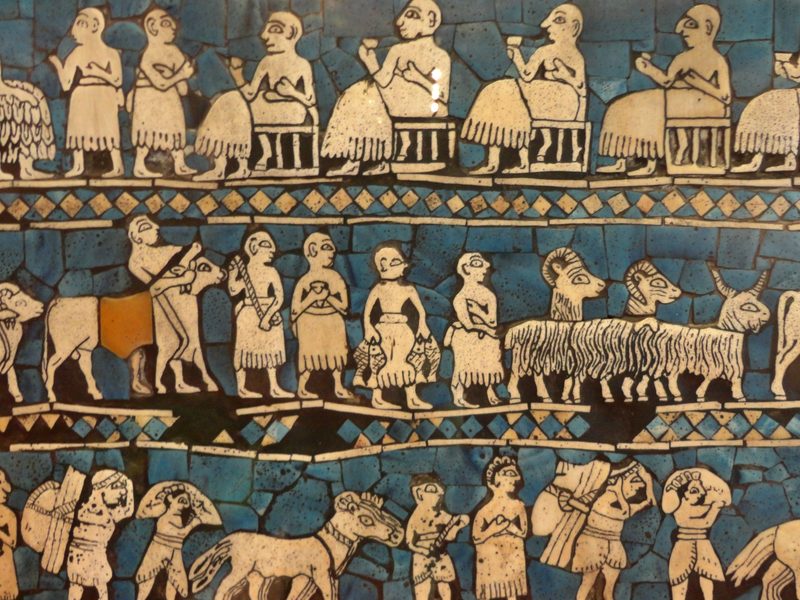
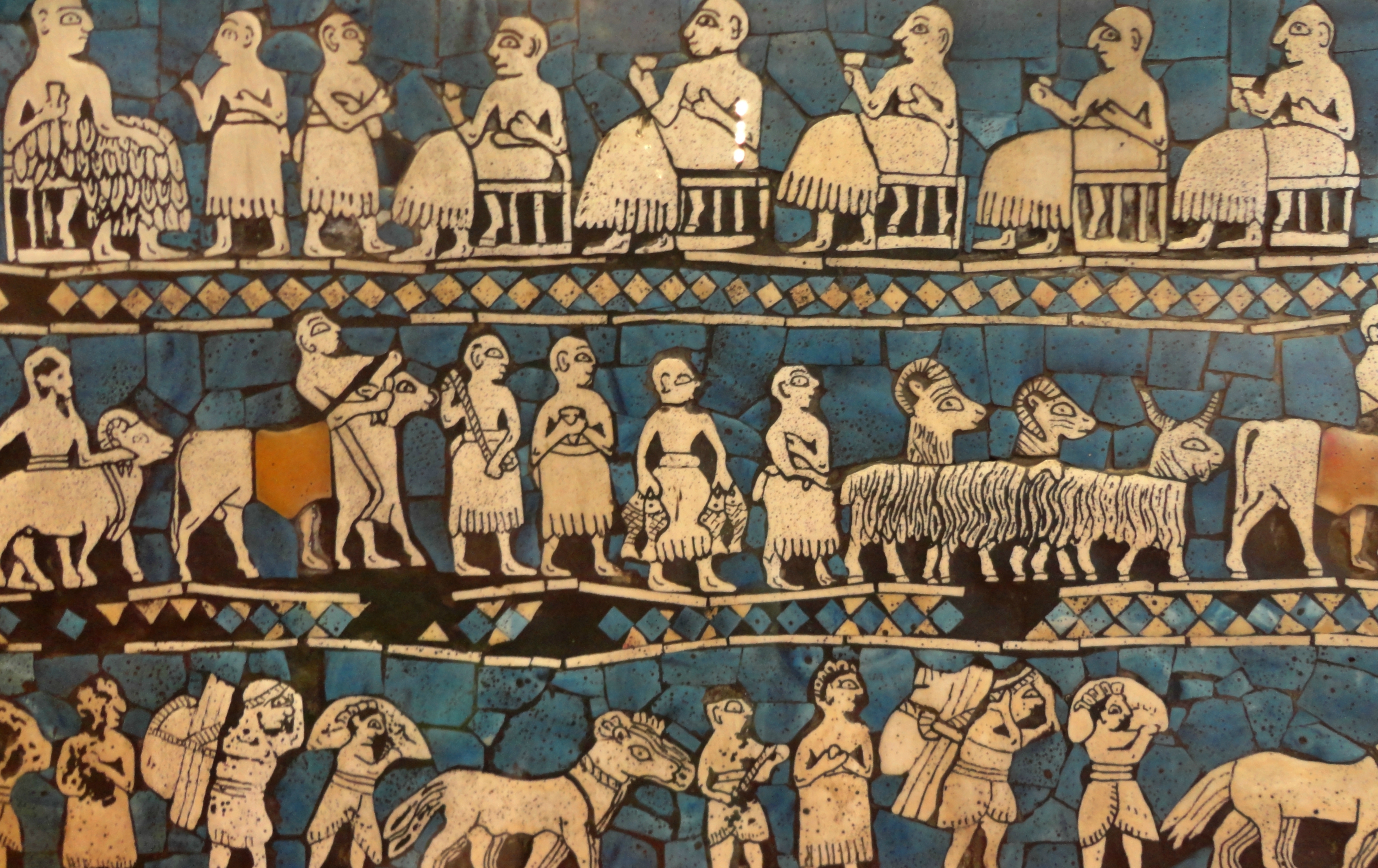
The Standard of Ur shows Sumerian society at the dawn of nationhood. The top register depicts a king presiding over banqueting; the bottom shows trade, agriculture, and organized labor. These are the markers of a nation: centralized authority, economic administration, and institutional hierarchy. This is the world Noah’s descendants entered at Sumer — and the form they carried to the ends of the earth.
This map tests the claim that what spread through that contact was nationhood itself: a specific way of organising a people, which Scripture identifies through markers like defined territory, centralised authority, and institutions that outlive their rulers. The world was already inhabited; the indigenous peoples of Australia, the Americas, and elsewhere were there long before Noah arrived. What spread to existing populations through contact with Noah’s descendants was something they did not yet have.
No people group became a nation without that contact. Every nation on earth today traces back through an unbroken chain to Noah’s sons at Sumer.
As you watch the nations form, consider this: the Inca and Aztec empires were vast and sophisticated, yet both collapsed within months when their rulers were captured. Old World nations don’t collapse this way. If the chain thesis is right, that contrast has an explanation.
Is the pattern plausible? Watch and judge.
Genesis 10; A Timeline of Origins (Russell, 2024)
The early chapters of Genesis make specific claims about history: a time, a place, specific structures, a particular people, a particular language. This walkthrough explores whether a coherent reading of those chapters can be found: one that meshes well with what archaeology and linguistics have independently discovered about the ancient world.
The reading being tested is this: that Adam and Noah’s descendants inhabited a world physically separate from ours. Cain was the first to enter our world, bringing with him a language that had no relatives here. At Babel, that language was scattered into a world already full of other tongues, absorbed into them and gone.
Watch the map and see how the evidence accumulates.
Genesis 11; A Timeline of Origins (Russell, 2024)
This walkthrough follows a single thread from the beginning of biblical history to the present. It asks you to watch a pattern.
“Everything written about me in the Law of Moses, the Prophets and the Psalms must be fulfilled.” Then he opened their minds so they could understand the Scriptures. He told them, “This is what is written: The Christ will suffer and rise from the dead on the third day, and repentance and forgiveness of sins will be preached in his name to all nations, beginning at Jerusalem.” (Luke 24:44–47)
Over 5,000 years, different authors in different centuries made specific predictions about a coming figure: that he would be a descendant of Eve, of Abraham, of David; that he would die as a guilt offering for sin; that he would be pierced in Jerusalem; that he would rise from the dead; that the news would reach every nation on earth.
Watch where those predictions point. Then decide what you think.
You have watched the promises accumulate over 5,000 years. A descendant of Eve. A blessing for all nations through Abraham. A guilt offering greater than any animal. An eternal king from David’s line. A man who would be pierced in Jerusalem and then see the light of life again.
These were written by different people, across different centuries, and they converge on one person. That convergence is either the most remarkable coincidence in history, or it is exactly what it claims to be: a story that was known in advance.
Jesus said: “Everything written about me in the Law of Moses, the Prophets and the Psalms must be fulfilled.” (Luke 24:44)
Jesus died to pay for your sin. He rose again to give you new life. That offer is open to anyone who turns to him.
If you want to respond, you could pray something like this — not as a magic formula, but as a genuine turning toward God:
Lord God, I’m sorry that I have rejected you as the ruler of my life. I need your forgiveness. Thank you for sending Jesus to die in my place. Thank you that he rose again to give me new life. Please forgive me and change me, that I might live with Jesus as my ruler. Amen.
If you have prayed that prayer and meant it, you may feel different — or you may not. Feelings are not the point. The important thing is this: you can be confident that God has answered. He did the hard thing by sending his Son to die for you. Answering the prayer of someone who genuinely turns to him — that is the easy thing. He will do it.
Tell someone. Find a church where the Bible is taught. Read Luke’s Gospel.
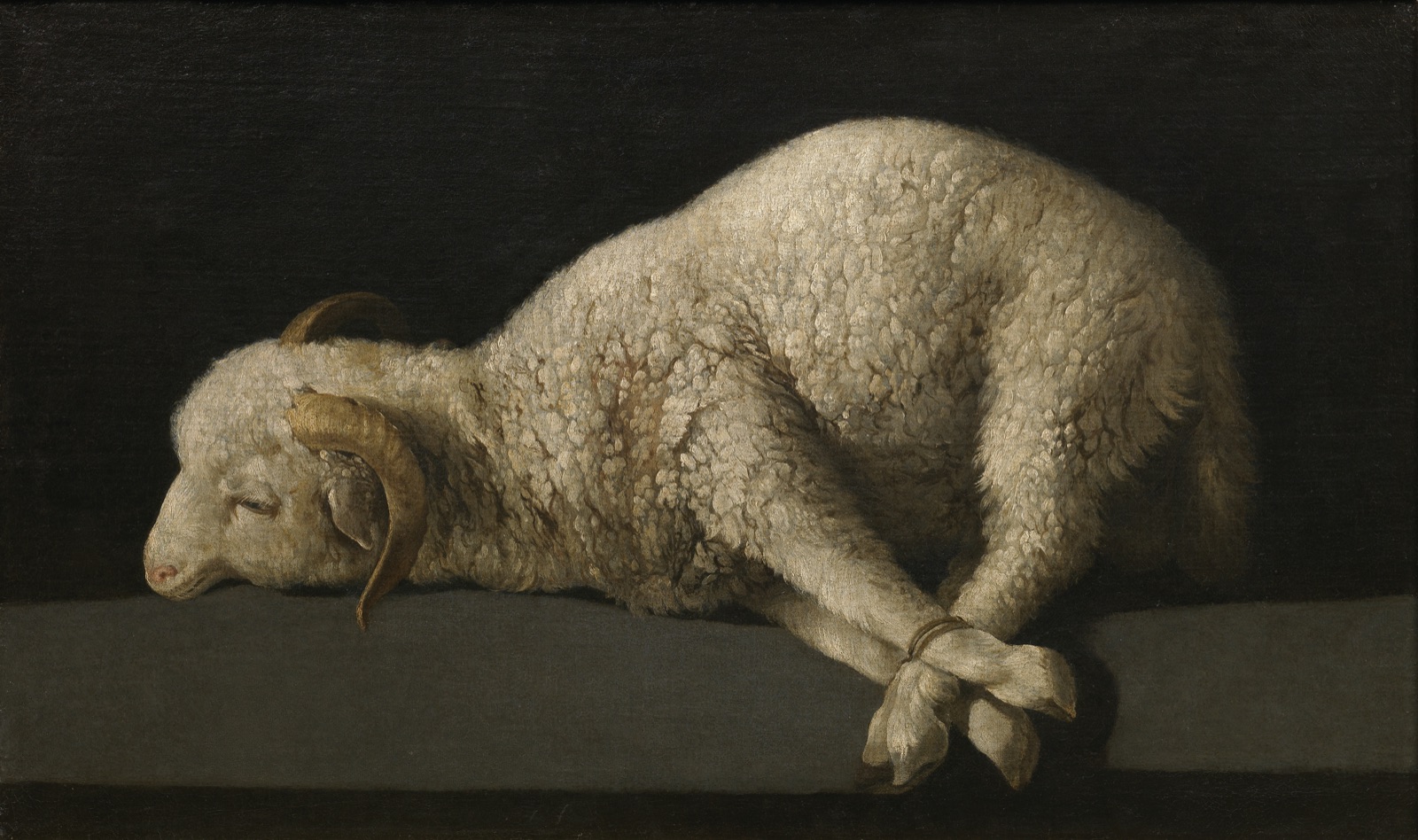
In ancient Israel, when someone sinned, they brought an animal to the priest. The animal was killed. The idea was precise: sin deserves death. A substitute dies. The guilty person goes free.
“The priest shall make atonement for him with the ram of the guilt offering, and he will be forgiven.” (Leviticus 5:16)
But the system itself raises a problem it cannot solve. What if a person’s guilt is too great for any animal to pay for? What if the offence is against someone infinitely great? An animal’s death is finite. A finite payment cannot cover an infinite debt.
Isaiah 53, written 700 years before Christ, gives the answer: a man — not an animal — will give his life as a guilt offering. And because this man is also the Son of Man of Daniel 7 (who must be God, since all nations worship him), his death is not finite. It is sufficient to pay for the guilt of the whole world.
That is why Jesus, at the Last Supper, said: “This is my body given for you... this cup is the new covenant in my blood, poured out for you.” He was identifying himself as the guilt offering Isaiah described.
Isaiah writes around 700 BC — seven centuries before Jesus. He describes a man who suffers, is pierced, carries the sins of many, and is killed. And then, remarkably: “After the suffering of his soul, he will see the light of life.” (Isaiah 53:11) He does not stay dead.
The passage was so widely known in first-century Judaism that one of the Dead Sea Scrolls (dated before 100 BC) contains the entire text, word for word as we have it today. This is not a text Christians invented after the fact. It was in the hands of Jews who were still waiting for it to be fulfilled when Jesus was born.
When the Ethiopian official in Acts 8 is reading this very passage and asks “Who is the prophet talking about?”, Philip explains that it refers to Jesus. The first Christians did not search for texts to fit Jesus. They found that the texts they already had pointed precisely to him.
The Old Testament is unmistakeable on one point: only God is to be worshipped. “You shall have no other gods before me.” (Exodus 20:3). Yet Daniel 7 describes a figure who receives worship from all peoples of every language — worship that “will not pass away.” Therefore this figure must be God.
Psalm 45 addresses the coming king directly as “O God” (v.6). Psalm 72 says all kings will bow down to him. The Christ who is worshipped forever must be divine.
There is also a logical reason: only God can pay an infinite debt. Our sin is against someone infinitely holy. The price of that offence is infinite. A finite person’s death cannot pay an infinite debt. Only God — who is infinite — can. That is why the guilt-offering man must be God himself.
Jesus accepted this conclusion. When the high priest asked him directly, “Are you the Christ, the Son of the Blessed One?”, Jesus replied: “I am. And you will see the Son of Man sitting at the right hand of the Mighty One and coming on the clouds of heaven.” (Mark 14:61–62). He was claiming to be the figure of Daniel 7. The high priest understood exactly what he was claiming — and called it blasphemy.
500+ eyewitnesses. Paul writes in the mid-50s AD, about 20 years after the resurrection, listing those who had seen the risen Jesus: Peter, the twelve disciples, “more than five hundred of the brothers and sisters at the same time, most of whom are still living” (1 Corinthians 15:6). He is inviting scrutiny. Go and ask them, he says.
The empty tomb. Jesus’ enemies never denied the tomb was empty. They only tried to explain it away (Matthew 28:13). The emptiness of the tomb was accepted by all sides as a historical fact.
James, Jesus’ own brother. James did not believe in Jesus during his lifetime (John 7:5). After the resurrection, he became a leader of the Jerusalem church and died for his faith. The most plausible explanation: he saw his brother alive after death.
Paul, the persecutor. Paul was actively hunting down Christians when he experienced a dramatic reversal. He claimed to have seen the risen Jesus (1 Corinthians 15:8) and spent the rest of his life proclaiming it at personal cost. People do not give their lives for something they know to be a lie.
The change of the Sabbath. Jews had kept Saturday as the holy day for a thousand years, commanded in the Ten Commandments. The early Jewish Christians began meeting on Sunday — because Jesus rose on Sunday. They were willing to change a fundamental practice because they were absolutely certain of what they had seen.
The chain begins at an established fact: 853 BC, confirmed by the Assyrian Kurkh Monolith. From there, the biblical genealogies run continuously to Adam at approximately 5159 BC.
Reaching that date requires a number of chronological decisions. One of the most significant is the fathering ages in Genesis 5 and 11: the Septuagint (LXX) gives systematically higher ages than the Masoretic Text (MT) used in most English Bibles, producing a date for Adam around 5159 BC rather than 4000 BC. The shorter MT figures place Adam in the middle of the early Bronze Age, among existing civilisations with their own long histories. The longer LXX figures place him before the historical record begins: an earlier world, separate from ours. That is where we would expect him to be.
Two ends of the chain are independently anchored. The chronology set out here connects them. That is the argument.