Can Ancient DNA Test Noah’s Arrival?
What human, sheep and grapevine evidence near Cudi Dağı can—and cannot—show
Research report · 16 July 2026
This site proposes that Noah and the ark arrived in our already inhabited world near Cudi Dağı around 2900 BC. That proposal makes a testable prediction: if the new arrivals mixed with nearby populations, ancestry not previously represented in the region might appear around that time.
We tested that prediction with the currently available human ancient DNA. We also audited the available ancient evidence for two related possibilities: that the arrivals brought a distinctive sheep population, and that a distinctive grapevine lineage appeared in the region. The result is not positive evidence for the proposal. It is a record of what was tested, what was found, and what the surviving evidence is presently capable of deciding.
Result at a glance
No unexplained human ancestry signal was detected. The usable Başur Höyük individuals differ from the small pre-2900 BC Tatika comparison panel, but known regional populations adequately explain that difference. The result weighs against a large, genetically distinctive population replacement. Because the surviving local sample is very small, it has little power to detect a small family contribution or ancestry resembling neighbouring populations.
| Evidence | Status | Present conclusion |
|---|---|---|
| Human ancient DNA | Test completed | No unexplained ancestry was detected. Observed differences are compatible with ordinary regional movement; small contributions remain difficult to detect. |
| Sheep ancient DNA | Data audited | Not presently testable: no directly dated local sheep genomes adequately bracket 2900 BC. |
| Grapevine evidence | Data audited | Not presently testable: no suitable local ancient grape genomes bracket the proposed date. New sequencing and direct dating would be required. |
The human ancient-DNA pilot
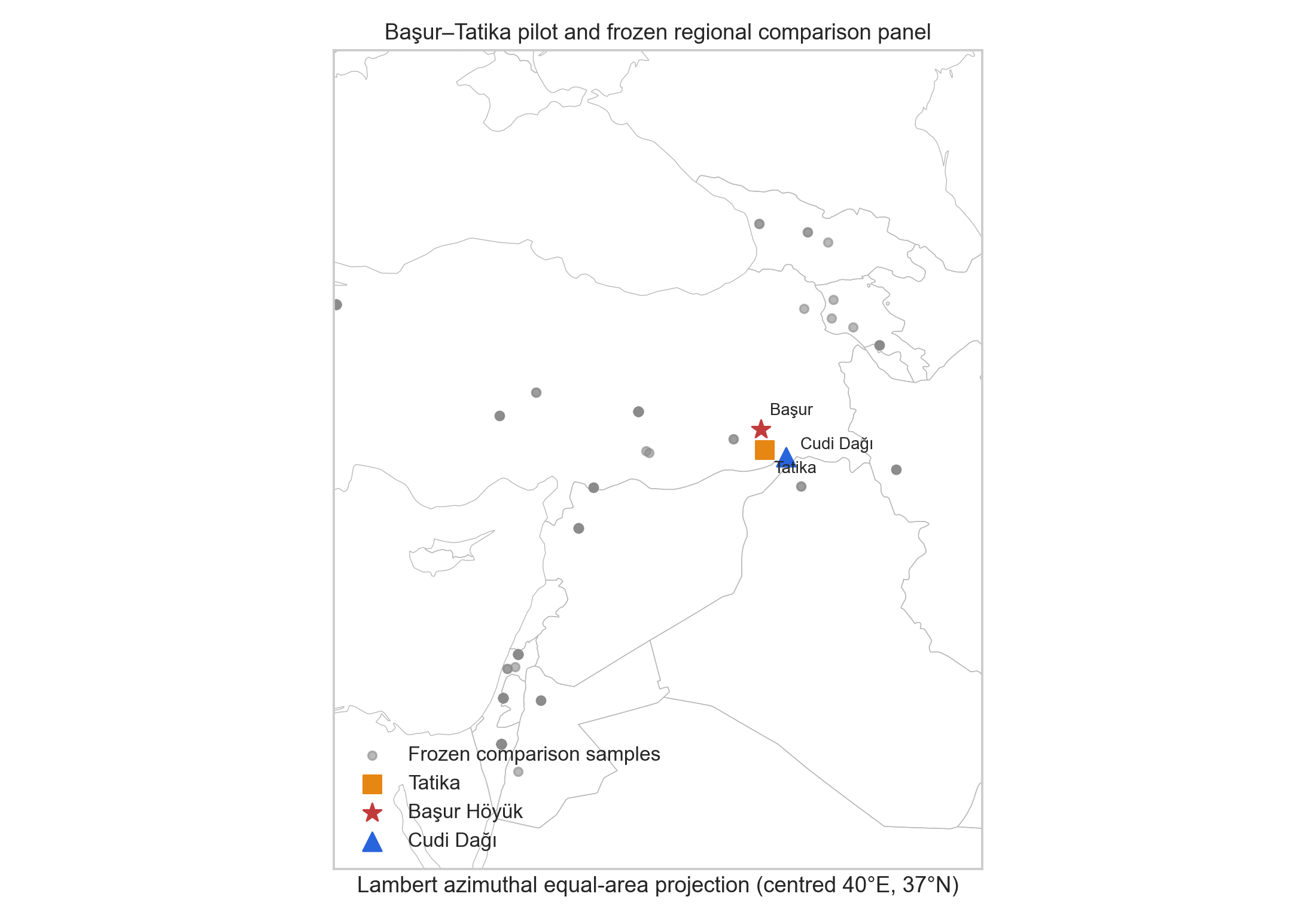
The analysis was preregistered before the newly processed Başur genome-wide results were examined. Four Başur Höyük capture datasets were processed from raw reads. Only two individuals passed the frozen requirements for primary ancestry analysis: SK1096, associated with a mass-burial context at about 2880 BC, and SK1080, from the broader 3100–2750 BC cemetery context. A third individual was too sparse for primary analysis, and a fourth failed the ancient-DNA authenticity test.
The published Tatika record contains five securely pre-2900 individuals, two whose ranges cross or touch 2900, and five securely later individuals. After applying the frozen quality threshold, the strict local pre-event panel contained three individuals. Only two securely later Tatika genomes had enough data for the main genome-wide comparison. The two boundary-dated individuals were excluded from the primary pre/post test.
What the analysis found
A model using only the three-person Tatika pre-event panel did not adequately fit either usable Başur individual when tested against the full rotating comparison panel. That means the Başur individuals contain ancestry not fully represented by those three local people. It does not mean the ancestry was new to the region.
Several known Late Chalcolithic and Early Bronze Age populations from neighbouring parts of Anatolia, Upper Mesopotamia and the southern Caucasus fit the Başur individuals. The selected known-regional model remained acceptable through all 35 leave-one-comparison-population-out tests and every eligible processing sensitivity. Neither Başur individual was an outlier among the available contemporary regional controls. Under the preregistered rules, this is the pattern of ordinary regional differentiation, not an unexplained anomaly.
The securely later Tatika group could be modelled from Tatika pre-event ancestry in the primary analysis. One statistical comparison was borderline, but it changed when boundary dates, individual samples and family relationships were handled differently. It is therefore not evidence of a robust population discontinuity.
How likely was this pilot to detect a real event?
There is no single detection probability for “Noah arrived near Cudi.” A landing does not determine how quickly the family mixed with local people, how much ancestry they contributed, or how genetically different they were. Power can be stated only for a defined hypothetical contribution to the populations represented by the samples.
In an optimistic simulation, if the proposed arrivals had contributed 10% of the ancestry of the populations represented at Tatika and Başur—approximately 55 and 90 km from Cudi—during the first few centuries after 2900 BC, this sample design had only about a 6–20% probability of detecting the resulting change. The lower estimate applies if the newcomers resembled neighbouring populations genetically; the upper estimate assumes a highly distinctive source.
Equivalently, the design had roughly an 80–94% probability of missing that specified 10% contribution. These are optimistic design simulations, not the probability that the Cudi proposal is true or false. The probability of meeting the report’s stricter definition of an unexplained anomaly may be lower.
The calculation also should not be extended to everyone within an arbitrary radius. The study contains people from two sites, not a representative sample of a 250 km circle. Its dates are imperfect as well: the usable post-event Tatika ranges extend from shortly after 2900 BC to as late as about 2500 BC; one Başur individual is associated with about 2880 BC, while the other has a broader context date crossing the proposed boundary.
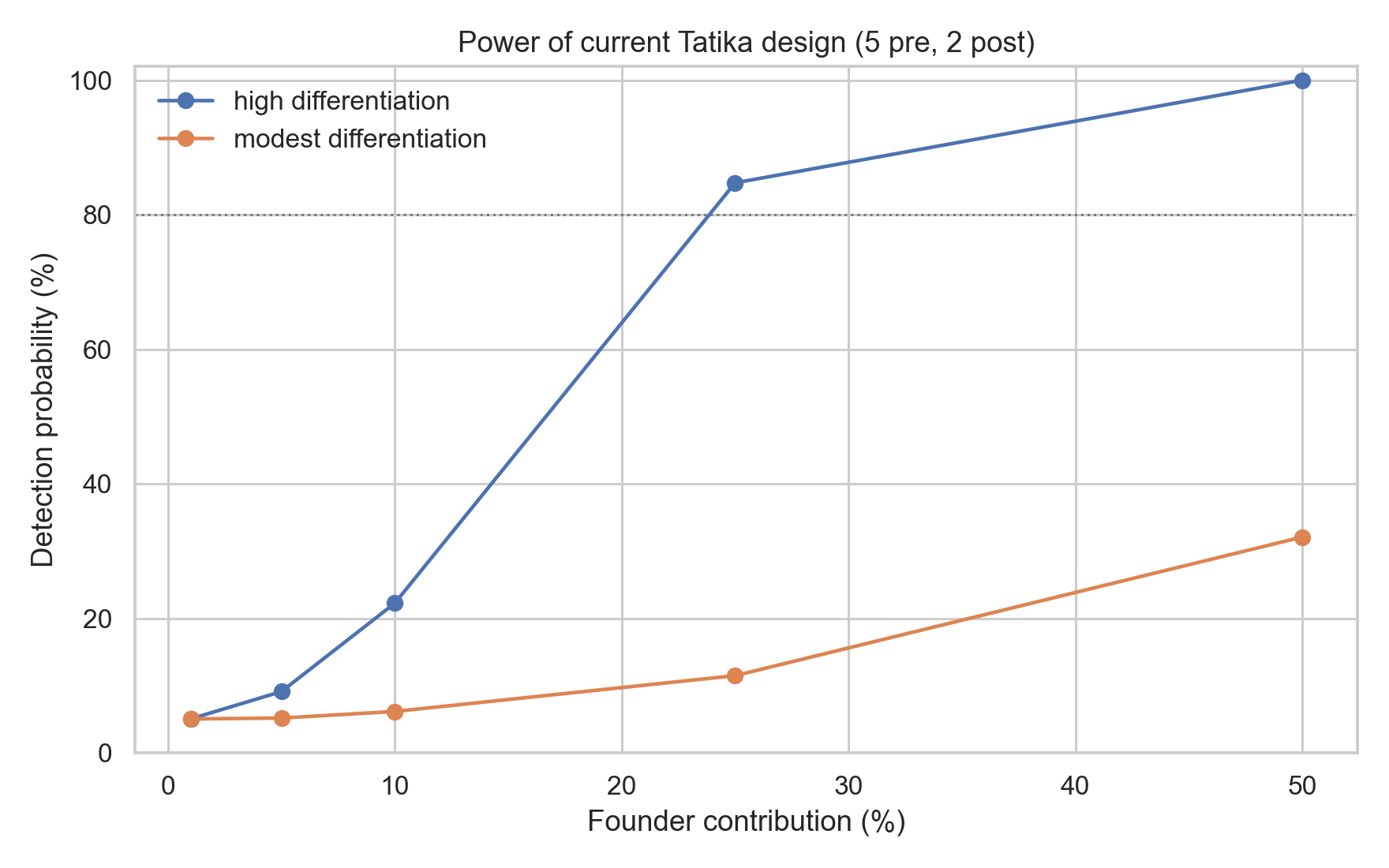
A large and distinctive population change would have been much easier to find. In the strict three-versus-two simulation, a 25% contribution from a highly differentiated source had about 78% power, and a 50% contribution was almost certain to be detected. The negative result therefore counts against a major genetically distinctive replacement, while saying much less about the arrival of one extended family, limited intermarriage, or ancestry similar to that already present in West Asia.
The sheep audit
The sheep audit examined 120 public sample records from the major ancient-sheep genomic dataset. Only one sample lies within 250 km of Cudi, and it is a wild Körtik Tepe mouflon dated about seven millennia too early. Four Yanik Tepe sheep and two Ali Abad sheep lie within 500 km and have archaeological ranges crossing 2900 BC, but none has a specimen-specific calibrated date capable of placing it securely before or after the proposed event.
The existing data can supply a broad Eurasian comparison panel, but they cannot test an abrupt local change. The missing evidence is a directly dated Upper Tigris/Cudi time series immediately before and after 2900 BC. This is a finding about data availability, not a negative result for the hypothesis.
The grapevine audit
The grapevine audit examined public ancient grape DNA, regional archaeobotanical reports and modern comparison genomes. It found no public genome-wide ancient grape sample within 1,000 km of Cudi in the crucial 4000–1500 BC interval, and no directly dated local genomic series bracketing 2900 BC.
Potential material exists in archaeological collections. Areni-1 has directly dated grape wood on both sides of the boundary but a gap of more than a millennium around it; Arslantepe has promising pre- and post-boundary contexts, but the remains are charred, sparse and not directly dated. Nearby sites preserve grape pips or processing remains, but none has yet yielded the local ancient genomes needed for this test. The hypothesis is potentially testable through new sequencing and direct dating, but it is not testable from public data now.
What would make the test decisive?
The greatest need is not a more elaborate analysis of the same few genomes. It is new, directly dated sampling:
- unrelated human individuals from the same local sites, tightly dated on both sides of 2900 BC;
- enough authentic DNA for contamination estimates and damage-restricted replication;
- denser regional human sampling from the Upper Tigris, northern Mesopotamia, the Zagros and southern Caucasus;
- a directly dated local sheep sequence before, during and after the proposed event;
- preserved grape pips, wood or pedicels from matched local contexts, directly dated and screened for recoverable nuclear DNA.
An optimistic planning model suggests that detecting a 10% contribution from a highly distinctive human source with 80% power would require about 16 good-quality unrelated individuals on each side of the boundary. If the source were only modestly differentiated, even hundreds per side might be required. Better local and regional representation is as important as the raw count.
Limits of interpretation
No genetic result could identify Noah, Cain or any other named person. An ancestry component cannot identify a people, recover a spoken language or distinguish an extraordinary migration from an ordinary one without independent evidence. Even a future replicated unexplained outlier would first be a reason to seek more samples and better regional models.
The present conclusion is narrower: the available human genomes contain no ancestry difference that requires an unknown source, while the available sheep and grapevine evidence is not yet sufficient to run the proposed tests.
Full methods and results
The technical report records the preregistered question, sample verification, raw-read processing, authenticity checks, PCA, qpWave, f-statistics, rotating-source qpAdm models, kinship screening, sensitivity analyses and power simulations. It also states the analysis deviations and the conditions under which the test could become decisive.
Download the full technical report (Markdown)
Primary data sources: ENA project PRJEB83032; AADR v66.p1 (DOI); the Southern Arc study; and the Başur Höyük archaeological publication.